
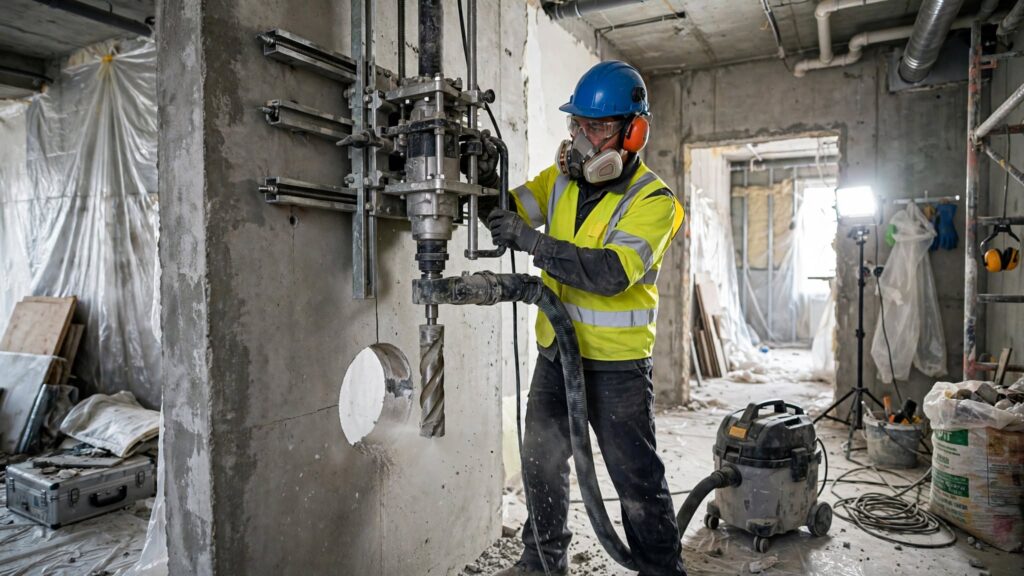
Structural renovation often requires creating new openings in concrete without disturbing the surrounding building elements. A contractor may need to route plumbing through a reinforced slab, install electrical conduits through a wall, add ventilation systems, or prepare openings for new building services. These tasks demand more control than simply breaking through concrete.
Core drilling provides that control. By using a cylindrical, diamond-tipped drilling bit, contractors can create clean, accurately sized openings in concrete, masonry, and other hard construction materials. When properly planned and carried out, core drilling supports precise structural renovations while helping limit unnecessary damage to nearby surfaces.
What Is Core Drilling?
Core drilling is a concrete cutting technique used to produce circular openings in structural materials. Instead of crushing or chipping away a large area, the drill removes a cylindrical section called a core.
The equipment generally uses a hollow drill bit fitted with diamond segments. As the bit rotates, it gradually cuts through the material while maintaining the required diameter. Depending on the project, drilling may be performed horizontally, vertically, or at an angle.
This makes concrete core drilling useful for renovation work where openings must match the dimensions and locations specified in construction drawings.
Why Precision Matters During Structural Renovations
Existing buildings contain more than visible concrete walls and floors. Reinforcement, electrical lines, plumbing, post-tensioning systems, and other components may be concealed inside or behind structural elements.
An opening made in the wrong position can interfere with these systems or require additional repair work. Accurate layout is therefore an important part of any concrete drilling operation.
Before drilling begins, contractors may review structural drawings, verify measurements, inspect the work area, and use appropriate scanning methods where hidden services or reinforcement are a concern.
Controlled Openings Reduce Unnecessary Removal
Core drilling focuses material removal on the required opening. For example, if a renovation requires a circular penetration for a pipe, removing a much larger section of concrete would create extra repair work.
A properly selected core bit produces an opening close to the required size. This can make subsequent installation and finishing work more straightforward.
The same principle applies to larger concrete cutting projects. Techniques discussed in The Advantages of Diamond Wire Sawing for Large Structures also show why selecting a cutting method according to the size, material, and structural conditions of the project matters.
Common Uses of Core Drilling in Renovation Projects
Core drilling can support many building modifications, particularly when mechanical, electrical, and plumbing systems are being upgraded.
Typical applications include openings for:
- Plumbing and drainage pipes
- Electrical conduits and cable routes
- HVAC ducts and ventilation lines
- Fire protection and sprinkler systems
- Utility connections between floors
- Anchoring and structural installation work
Consider an older commercial building being converted for a different use. New air-conditioning, electrical, and plumbing systems may need routes through existing concrete floors. Core drilling allows individual penetrations to be positioned according to the updated service layout rather than removing broad sections of the slab.
How Core Drilling Supports Safer Renovation Work
Core drilling itself does not remove the need for structural assessment or site safety procedures. Its advantage is that it can provide a controlled method of forming openings when the work has been properly evaluated beforehand.
Planning Around Reinforcement and Utilities
Before drilling into an existing structure, the proposed opening should be checked against available drawings and site conditions. Where necessary, scanning can help identify reinforcement, cables, pipes, or other embedded components.
This step is especially important when drilling through structural slabs, beams, columns, or walls where an incorrectly positioned opening could affect more than the surface finish.
Managing Water, Slurry, and Dust
Some core drilling operations use water to cool the diamond bit and help manage dust. This creates slurry that must be contained and removed appropriately, particularly inside occupied or finished buildings.
Dry drilling may be considered in certain situations, but the suitable method depends on the material, equipment, location, and project requirements. Dust extraction and work-area isolation may also be necessary.
Factors That Affect a Core Drilling Job
Not every structural renovation requires the same drilling setup. Contractors need to consider several conditions before selecting equipment and drilling methods.
The thickness and strength of the concrete influence the drilling process, while the required hole diameter determines the core bit size. Reinforcement can also affect how the opening is planned and executed.
Access is another practical issue. A penetration near a ceiling, corner, narrow service area, or elevated slab may require a different drilling arrangement than an opening in an easily accessible wall.
The drilling angle also matters. Although many penetrations are perpendicular to the surface, renovation designs sometimes require angled openings to accommodate specific service routes.
Core Drilling Versus Conventional Breaking Methods
Breaking tools have an important role in demolition, but they are not always suitable for creating neat penetrations. Chipping or hammering can remove more material than required and may leave irregular edges that need additional finishing.
Core drilling serves a different purpose. It is designed to create defined circular openings while concentrating the cutting action within a limited area.
The appropriate method still depends on the task. Large sections of concrete may require wall sawing, slab sawing, wire sawing, or controlled demolition rather than core drilling. Choosing the technique according to the intended opening helps avoid unnecessary work.
Preparing for Successful Concrete Core Drilling
Good results begin before the drill touches the surface. The location and diameter of each opening should be confirmed against the renovation plans, and the surrounding area should be assessed for potential hazards or obstructions.
It is also important to consider what is on the opposite side of the drilling surface. The concrete core may become loose when the cut is completed, so the exit area needs appropriate control.
After drilling, the opening should be inspected to confirm that it meets the requirements of the installation. Any necessary sealing, firestopping, waterproofing, or finishing can then be completed according to the purpose and location of the penetration.
Conclusion
Core drilling gives renovation teams a controlled way to create openings in existing concrete and masonry structures. Its ability to produce accurately sized penetrations makes it particularly useful for plumbing, electrical, HVAC, fire protection, and other building-service upgrades.
Precision, however, depends on careful preparation. Reviewing structural conditions, locating concealed services, selecting suitable equipment, controlling slurry or dust, and planning the exit side of the opening are all important parts of the process. When these factors are addressed properly, core drilling can support structural renovations with less unnecessary material removal and more control over the finished opening.