
Introduction
Concrete Demolition plays a critical role in construction, renovation, and infrastructure projects. Every year, the United States generates more than 600 million tons of construction and demolition debris, according to the U.S. Environmental Protection Agency. Selecting the right demolition method directly impacts project costs, timelines, worker safety, and environmental outcomes. A poorly chosen technique can increase labor expenses, delay schedules, and create unnecessary waste.
Modern construction projects require precise planning before any demolition begins. Factors such as concrete thickness, reinforcement density, site access, noise restrictions, and nearby structures influence the best approach. We have seen projects reduce demolition time by up to 35% by matching the method to site conditions. Experienced contractors evaluate these variables before selecting equipment and procedures.
Understanding available demolition techniques helps project owners make informed decisions. From mechanical breaking to controlled demolition and advanced cutting methods, each solution serves a unique purpose. This guide explores the most effective Concrete Demolition methods, their benefits, limitations, and ideal applications to help you choose the right solution for your project.
Types of Concrete Demolition Methods
Mechanical Concrete Demolition
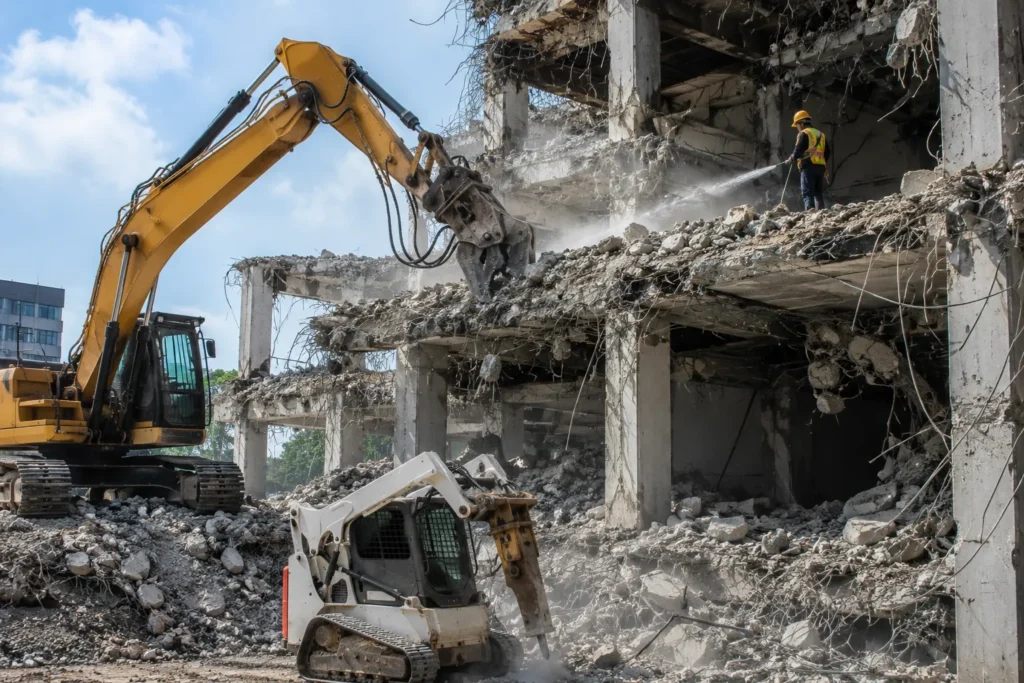
Mechanical demolition remains the most widely used Concrete Demolition technique in commercial and residential construction. This method uses hydraulic breakers, excavators, bulldozers, and specialized demolition attachments to remove concrete structures efficiently. Contractors often choose this approach for foundations, parking structures, bridges, and industrial facilities.
Large hydraulic breakers can deliver over 1,000 blows per minute, making them highly effective for thick reinforced concrete. The method provides fast production rates and lower labor requirements compared to manual techniques. However, it generates significant noise, vibration, and dust. These factors can limit its use in urban environments or near occupied buildings.
Key advantages include:
- Fast removal of large concrete sections.
- Lower labor costs.
- Suitable for reinforced concrete.
- Efficient for large-scale projects.
- Readily available equipment.
Mechanical demolition works best when speed and volume are the primary project requirements. Explore our solutions for How Underwater Infrastructure Is Shaping the Future of Global Connectivity.
Advanced Concrete Demolition Techniques
Diamond Sawing and Wire Cutting
Diamond sawing has transformed modern Concrete Demolition projects by providing precision and control. Contractors use diamond blades and wire systems to cut concrete structures without causing excessive vibration. This method is common in hospitals, airports, power plants, and occupied commercial buildings.
Diamond wire saws can cut concrete sections exceeding 10 feet in thickness. The technology allows contractors to remove specific portions while preserving surrounding structures. In our experience, diamond cutting often reduces repair costs because it minimizes collateral damage. Although equipment costs are higher, the precision frequently offsets those expenses through reduced restoration work.
The following table compares common demolition methods:
| Method | Best Application | Noise Level | Precision | Speed |
|---|---|---|---|---|
| Mechanical Breaking | Large structures | High | Low | Fast |
| Diamond Sawing | Precision removal | Low | High | Moderate |
| Hydrodemolition | Surface removal | Medium | High | Moderate |
| Controlled Explosives | Massive structures | Very High | Medium | Very Fast |
Hydrodemolition Technology
Hydrodemolition uses high-pressure water jets to remove damaged concrete while preserving embedded steel reinforcement. Water pressures typically range from 15,000 to 40,000 psi. This method is widely used for bridge rehabilitation, parking garages, and transportation infrastructure.
Engineers favor hydrodemolition because it creates an excellent bonding surface for repair materials. The process removes deteriorated concrete without introducing microcracks into the remaining structure. Studies from transportation agencies show repair longevity can improve by more than 25% when hydrodemolition is used instead of conventional jackhammering.
Factors to Consider When Choosing a Demolition Method
Project Size, Safety, and Environmental Requirements
Selecting the proper Concrete Demolition solution requires evaluating several project-specific factors. The first consideration is project scale. Large industrial structures may benefit from mechanical demolition, while precision renovations often require diamond cutting or hydrodemolition.
Safety remains a top priority. The Occupational Safety and Health Administration reports thousands of construction injuries annually involving demolition activities. Proper planning, equipment selection, and worker training significantly reduce risks. We recommend conducting a structural assessment before demolition begins to identify hazards and determine safe removal sequences.
Environmental requirements also influence method selection. Many municipalities enforce strict regulations regarding dust, noise, and debris disposal. Contractors increasingly adopt sustainable practices by recycling demolished concrete into aggregate products. Recycled concrete aggregate can replace up to 100% of natural aggregate in certain applications, reducing landfill waste and conserving resources.
Important decision factors include:
- Concrete thickness and strength.
- Presence of steel reinforcement.
- Site accessibility.
- Noise and vibration restrictions.
- Budget requirements.
- Project schedule.
- Environmental regulations.
Conclusion
Concrete Demolition requires more than simply breaking and removing concrete. The most successful projects begin with careful planning and method selection. Mechanical demolition offers speed for large structures, while diamond sawing provides unmatched precision. Hydrodemolition delivers excellent results for rehabilitation projects where preserving reinforcement is critical.
We consistently find that matching demolition techniques to project conditions improves safety, reduces costs, and minimizes disruptions. Factors such as structural complexity, environmental restrictions, and project timelines should guide every decision. By understanding the strengths and limitations of each method, project owners can achieve efficient demolition outcomes while protecting surrounding structures and maintaining compliance with modern construction standards. Choosing the right Concrete Demolition solution ultimately leads to safer operations, better project performance, and long-term value.